lproven: (Default)
Today's selection from Delancey Place is important but troubling.

delanceyplace.com 3/15/11 - the truth wears off
In today's excerpt - the truth wears off:

"On September 18, 2007, a few dozen neuroscientists, psychiatrists, and drug-company executives gathered in a hotel conference room in Brussels to hear some startling news. It had to do with a class of drugs known as atypical or second-generation antipsychotics, which came on the market in the early nineties. The drugs, sold under brand names such as Abilify, Seroquel, and Zyprexa, had been tested on schizophrenics in several large clinical trials, all of which had demonstrated a dramatic decrease in the subjects' psychiatric symptoms. As a result, second-generation antipsychotics had become one of the fastest-growing and most profitable pharmaceutical classes. By 2001, Eli Lilly's Zyprexa was generating more revenue than Prozac. It remains the company's top-selling drug.

"But the data presented at the Brussels meeting made it clear that something strange was happening: the therapeutic power of the drugs appeared to be steadily waning. A recent study showed an effect that was less than half of that documented in the first trials, in the early nineteen-nineties. Many researchers began to argue that the expensive pharmaceuticals weren't any better than first-generation antipsychotics, which have been in use since the fifties. 'In fact, sometimes they now look even worse,' John Davis, a professor of psychiatry at the University of Illinois at Chicago, told me.

"Before the effectiveness of a drug can be confirmed, it must be tested and tested again. Different scientists in different labs need to repeat the protocols and publish their results. The test of replicability, as it's known, is the foundation of modern research. Replicability is how the community enforces itself. It's a safeguard for the creep of subjectivity. Most of the time, scientists know what results they want, and that can influence the results they get. The premise of replicability is that the scientific community can correct for these flaws.

"But now all sorts of well-established, multiply confirmed findings have started to look increasingly uncertain. It's as if our facts were losing their truth: claims that have been enshrined in textbooks are suddenly unprovable. This phenomenon doesn't yet have an official name, but it's occurring across a wide range of fields, from psychology to ecology. In the field of medicine, the phenomenon seems extremely widespread, affecting not only antipsychotics but also therapies ranging from cardiac stents to Vitamin E and antidepressants: Davis has a forthcoming analysis demonstrating that the efficacy of antidepressants has gone down as much as threefold in recent decades. For many scientists, the effect is especially troubling because of what it exposes about the scientific process. If replication is what separates the rigor of science from the squishiness of pseudoscience, where do we put all these rigorously validated findings that can no longer be proved? Which results should we believe? Francis Bacon, the early-modern philosopher and pioneer of the scientific method, once declared that experiments were essential, because they allowed us to 'put nature to the question.' But it appears that nature often gives us different answers....

"[Joseph Banks Rhine, a psychologist at Duke, came to call this trend toward a reduction in the strength of proof for a theory he had developed in the early nineteen-thirties] the 'decline effect.'

"According to John Ioannidis, an epidemiologist at Stanford University, the main problem is that too many researchers engage in what he calls 'significance chasing,' or finding ways to interpret the data so that it passes the statistical test of significance - the ninety-five-per-cent boundary invented by Ronald Fisher. 'The scientists are so eager to pass this magical test that they start playing around with the numbers, trying to find anything that seems worthy,' Ioannidis says. In recent years, Ioannidis has become increasingly blunt about the pervasiveness of the problem. One of his most cited papers has a deliberately provocative title: 'Why Most Published Research Findings Are False.'

"The problem of selective reporting is rooted in a fundamental cognitive flaw, which is that we like proving ourselves right and hate being wrong. 'It feels good to validate a hypothesis,' Ioannidis said. 'It feels even better when you've got a financial interest in the idea or your career depends upon it. And that's why, even after a claim has been systematically disproven' - he cites, for instance, the early work on hormone replacement therapy, or claims involving various vitamins - 'you still see some stubborn researchers citing the first few studies that show a strong effect. They really want to believe that it's true.' ...

"The disturbing implication of a study [conducted in the late nineteen-nineties by John Crabbe, a neuroscientist at the Oregon Health and Science University] is that a lot of extraordinary scientific data are nothing but noise. The problem, of course, is that ... dramatic findings are ... the most likely to get published in prestigious journals, since the data are both statistically significant and entirely unexpected. Grants get written, follow-up studies are conducted. The end result is a scientific accident that can take years to unravel.

"This suggests that the decline effect is actually a decline of illusion. While Karl Popper imagined falsification occurring with a single, definitive experiment - Galileo refuted Aristotelian mechanics in an afternoon - the process turns out to be much messier than that. Many scientific theories continue to be considered true even after failing numerous experimental tests. Verbal overshadowing might exhibit the decline effect, but it remains extensively relied upon within the field. The same holds for any number of phenomena, from the disappearing benefits of second-generation antipsychotics to the weak coupling ratio exhibited by decaying neutrons, which appears to have fallen by more than ten standard deviations between 1969 and 2001....

"Such anomalies demonstrate the slipperiness of empiricism. Although many scientific ideas generate conflicting results and suffer from falling effect sizes, they continue to get cited in the textbooks and drive standard medical practice. Why? Because these ideas seem true. Because they make sense. Because we can't bear to let them go. And this is why the decline effect is so troubling. Not because it reveals the human fallibility of science, in which data are tweaked and beliefs shape perceptions. (Such shortcomings aren't surprising, at least for scientists.) And not because it reveals that many of our most exciting theories are fleeting fads and will soon be rejected. (That idea has been around since Thomas Kuhn.) The decline effect is troubling because it reminds us how difficult it is to prove anything. We like to pretend that our experiments define the truth for us. But that's often not the case. Just because an idea is true doesn't mean it can be proved. And just because an idea can be proved doesn't mean it's true. When the experiments are done, we still have to choose what to believe."

If you wish to read further click here

author: Jonah Lehrer
title: "The Truth Wears Off"
publisher: The New Yorker
date: December 13, 2010
pages: 52-57
lproven: (Default)
This is a rather long reply to a post from [livejournal.com profile] ciphergoth. The question being, is it plausible that, in future, we will be able to resurrect people from their head, cryonically frozen post-mortem?

I am keenly interested in the prospect of whole-brain emulation, which strikes me as potentially plausible, with reasonable probability. For one thing, I think that this is one of the more doable routes to AI - rather than trying to build a mind from scratch, to instead try to bootstrap it by attempting to reproduce the existing biological structures.

This being the case, it begs an obvious question, as it were: once (implicit "if" here & from now on) we have WBE, then the next big desirable leap would be scanning a biological brain and running the resultant dataset on an emulation. IOW, Kurzeilian "uploading". This strikes me as a consummation devoutly to be wished.

However, I feel - as a long-ago biology grad - that the prospects for taking a complete adult brain, scanning it & getting any data out of it that is worth uploading are virtually 0. I will come back to this in a moment.

But this is starting with a living, functioning brain - albeit possibly impaired by old age, disease or trauma. (Because why would one choose to do it if alive & healthy?)

However, the prospects of doing it from a dead brain seem to me to be far closer to 0, in a Zeno's-Paradox sort of way. Once one is outside that critical 4min window of an oxygen-deprived brain, I suspect that the remaining amount of useful information drops precipitately, with every passing minute, and after 2-3x that 4min window, I suspect there isn't enough left to be worthwhile. Given some hand-waving magical technology for interpreting memories absent the consciousness that recorded them - and of course we don't know if different consciousnesses record them in compatible or even comparable formats - one might be able to retrieve some memories from a dead brain, but a mind? I doubt it.
Read more... )
lproven: (Default)
I am getting really concerned these days by a dangerous new trend that's catching on like a bad cliché among a lot of my friends & acquaintances who I thought were smarter & better-informed.

It's climate-change denialism.

I don't know quite what's causing it, but with my skeptical hat on, it's really worrying me. It's the new homeopathy/intelligent design/pendulum-dowsing; it's not based on reason or evidence, it's based, I think, on a distrust of authority, a resentfulness against the tide of eco-awareness, and the growing feeling that one has to Do One's Bit for the Environment. People seem to be reacting against it.

But there's more to it than that.

As I get more involved in the active skeptical movement, trying to find way to expose the legions of liars, scammers, frauds and charlatans who are making money and exploiting the gullible, it's tremendously vexing to see people swallowing this new brand of patent bullshit.

From where I stand, as a rational thinker with a materialist, monist, scientific worldview, there is an awful lot in the world that can, absolutely & unambiguously, be divided into fact & fiction. Not everything - one cannot prove which composer or poet is better; that is personal taste. But one can prove that homeopathy, acupuncture, chiropractic, dowsing, crystal healing, laying on of hands, etc. etc. do not work, for instance.

It is possible to test the power of prayer, or the reality of reincarnation, or clairvoyance or ESP, and they do nothing at all. Zero. No "maybe", no "mostly", nothing at all.

In scientific research, it is a little different. Science rarely gives "yes" or "no" answers to complex, difficult questions, & those without any scientific training do not understand the qualified answers that it does give, those of balanced probabilities.

The evidence that people do not understand probability is that the National Lottery, for instance, still exists & is profitable.

But in science, it is often nonetheless possible to say "according to all the evidence, this is real but that is not." There often isn't "proof"; it's a question of balancing the evidence for and the evidence against, doing Hard Sums and statistics, and saying "according to the best current evidence, we think this is what's happening." It's expressed in terms of probabilities, in chances of things, in terms of ranges of expected outcomes.

But the punters want Crown Court or Judge Judy or something. They want simple clear answers and proof. Well, tough. Deal with it. There are no such "yes, definitely" answers. But on such things, such fuzzy uncertain results, is built the great edifice of science, that created the computers you're reading this on, the drugs that save millions of lives, the airplanes that carry us around the planet and the space vehicles that provide us with a world that contains GPS units that come free inside cellphones.

So, for instance, in the question of climate change. It is settled; it was settled a decade or more before I was born, settled way back inthe 1950s. It is not controversial, there is no real debate.

What there is, is bullshit. FUD, it's called in the IT industry: Fear, Uncertainty & Doubt. It's been methodically fostered by the oil & other fossil-fuels industries, by politics & by big money, spreading lies & bullshit because they fear for their bottom lines.

The trouble is, nowadays, this big-money BS campaign is a trendy bandwagon to jump on. More and more people I know are doing so. They don't really know about the subject and they're generally not interested in going and finding out, but they lap up any news story or bit of media bollocks that appears to suggest in any way that the world's climate is in fact changing.

This winter, in north-western Europe, it's been the snow, the "big freeze". So one area temporarily goes cold, OMG, global warming isn't happening.

It's drivel. Pure unadulterated balls. Disinformation spread by the malicious, swallowed and evangelised by the gullible.

There was no "big freeze". Go read about the Frost Fairs on the Thames just 200 or 300Y ago to see what the climate in northern Europe used to be like. This was a small temporary fluctuation of the Gulf Stream that chilled us by 5°C or so for a month. It's a glitch, not a big freeze, and it's evidence for climate change, not against it, because we are changing the thermohaline circulation of the oceans, something so huge that we cannot replace it with any technology we have. The Gulf Stream moves one hundred times as much energy as the total output of human civilisation; we can't replace it, but we can break it. Right now, it's faltering, at least in part because of the meltwater from Greenland diluting what should be the extra-salty surface waters. Saltier water is heavier than less-salty water, so it sinks. Water it down with freshwater from melting glaciers, it's not heavier & it doesn't sink. Result, northern Europe freezes.

It saddens & infuriates me to see smart people accepting drivel, nonsense, crap & lies, because they think they're rebelling against the establishment or the government, when all they're doing is buying the paid-for propaganda of the oil cartels.

The thing is, if you actually went and did some reading, educated themselves from the sources and not from the propaganda, looked at the real evidence, not the industry whitewash, there is NO QUESTION. It's not an argument: it's an increasingly-desperate bunch of researchers versus a huge army of highly-paid marketers and professional liars who don't give a damn if the world fries. They'll have spent the money and died; they don't care.

There's a difference between a Skeptic and being sceptical; that's why we adopted the "k" in it. To be sceptical is to doubt; to be a Skeptic is to fight the bullshit of the credulous and the corrupt with facts, reason and logic. Climate-change deniers aren't Skeptics, they're just sceptical, but the thing is, they're not sceptical because the evidence doesn't add up; they're doubters because they're buying the crap disinformation pumped out by the petrochemical lobbyists and so on.

But once they've bought the lie, then like religious zealots, they won't even allow anyone to suggest it's not gospel truth. Mere evidence will not shake this belief.

And if showing people the facts won't persuade them, what the hell will? How many millions of species must go extinct, how many billions of humans must be displaced and die in famines and water wars?

(Nicked from myself in a FB comment)
lproven: (Default)
Couple of bits of particularly bad news that I have come across this week.

[1] M.I.T. joins climate realists, doubles its projection of global warming by 2100 to 5.1°C

Well worth reading the piece and the links thence.

In summary, if very serious action is not taken - big league stuff, not fooling around with pointless nonsense like off-setting and biofuels - then we're on line for a warming of up to seven centigrade by the end of the century. One of the problems with these reports, as one of the linked articles discusses, is that [a] people don't understand probability and [b] climate scientists cannot believe how very stupid people are, so the scientists phrase their reports in their normal cautious language: "temperatures may increase, maybe by this much but more likely by only this much, if emissions are not reduced..." Partly because they can't credit that nobody will do anything.

Personally, I'm a cynic; I don't believe anyone will do anything significant.

Reasons the figures are being adjusted are, for instance, that the oceans are not absorbing much CO2 any more - because they've been doing it as fast as they can for a couple of centuries already and now they are near saturated, so much so that large areas are now largely dead and devoid of multicellular life.

Also, whereas the report does address discoveries such as the failing rates of uptake by the biosphere, it does not consider major new threats, such as massive methane (and carbon dioxide) release from thawing permafrost (did you know that a quarter the Northern hemisphere is permafrost?) and melting seabed methane clathrates.

And these are all synergies - they reinforce one another. In other words, the MIT report is far too cautious in its predictions.

[2] Meanwhile, in Central Asia, Lake Balhkash is in imminent danger of drying up. Now that the Aral Sea is effectively gone - the biggest single man-made environmental disaster in the world, certainly in the 20th Century and possibly, arguably, of the industrial revolution so far, and I bet most people have never even heard of it - Balkhash is the largest body of water in Central Asia after the Caspian. However, unlike the seas, it's shallow: only 5m to 25m deep. But now, it's getting polluted and also starved of water - it's just not showing that much yet, because it's getting topped-up by all the melting glaciers.

OK, so, it's far away and won't impact Britain much, but that, in my book, is no reason to not care. These are the early-stage big obvious signs of the looming catastrophe.

[3] Japan's boffins: Global warming isn't man-made; Climate science is 'ancient astrology', claims report

Several leading Japanese scientists have spoken out against anthropogenic climate change. This is terrifying stuff - while Japan is a highly insular culture, it is also an influential one. And one with a terrible record in terms of environmental responsibility, from whaling to massive timber use. I cannot help but wonder who has bought these guys off.

This will give more fuel to the global-warming deniers, and so long as they are around and voting, they will doom us all, and our children and our childrens' children. After that, well, at this rate, all bets are off. Plastic-laminated picture books on how to chip stone tools, make bows and arrows and effective ways to hunt, prepare and eat rats and cockroaches might be the best gift for the great-grandkids, I reckon.

Not A Rhetorical Question: what would make people believe, short of actually seeing it themselves? Because by the time the figures are in, it will be too late to change anything significant.

My bet: we are on course for an ice-free world within a century or two. Synergistic effects will accelerate massively, the polar caps and glaciers all melt, sea levels rise by 70m (200') and the inundated coasts, melting permafrost and clathrates and CO2 saturation of the oceans kills off most marine species leaving huge dead zones. There will be rapid mass human die-offs on land, due to agricultural collapse and scarcity of fresh water. Rivers will dry up as the snows and glaciers feeding them disappear and the tree cover on high watersheds is cut down and burned, leading to flooding, soil loss and rapid desertification. There will be epic water wars. All this long before the fossil fuels run out.

It is almost funny. We are all in a bus, careening down a steep mountain road at ever-increasing speed, completely out of control, but lots of passengers think this is normal and are saying they're looking forward to getting to the bottom and the drivers are still arguing whether to brake or not.

I wonder when people will notice? I wonder if I will live to see it? I hope to make it to 2050 or so. By then, I reckon, we will have made only token efforts and it will be irreversible.
lproven: (Default)
Just before I head off to the X Electrical Jule party, a little note of gloom and despair to enliven this winter evening.

Too late? Why scientists say we should expect the worst
The cream of the UK climate science community sat in stunned silence as Anderson pointed out that carbon emissions since 2000 have risen much faster than anyone thought possible, driven mainly by the coal-fuelled economic boom in the developing world. So much extra pollution is being pumped out, he said, that most of the climate targets debated by politicians and campaigners are fanciful at best, and "dangerously misguided" at worst.
And on the other, very much less probable side...

Wind, water and sun beat other energy alternatives, study finds

Summary: for the US, given a national grid, wind power could work, especially supplemented with other renewables. They don't favour nuclear basically because of the risk of weapons. And check out their metric for the "carbon footprint" of nuclear power: estimating the CO2 release from bombs!
lproven: (Default)
Last day in Hannover (see Twitter passim), and I'm scouting around to see what's happening in the tech world. This story doesn't really quality, but it's interesting stuff.

From the Smithsonian magazine: the world's oldest temple: Göbekli Tepe, Urfa, Turkey.

This place is form the Neolithic, the last Stone Age, a full 11,000 years old. A full two millennia before Çatalhöyük. Before agriculture, before the domestication of animals. 6,000 years before Stonehenge or the invention of writing.
"There's more time between Gobekli Tepe and the Sumerian clay tablets [etched in 3300 B.C.] than from Sumer to today," says Gary Rollefson, an archaeologist at Whitman College in Walla Walla, Washington, who is familiar with Schmidt's work. "Trying to pick out symbolism from prehistoric context is an exercise in futility."
Literally awe-inspiring.
lproven: (Default)
Last week, there was the first private spacecraft to reach orbit - SpaceX's Falcon 1. And, marginally less impressively, since they're the world's largest country and the quickest-growing economy, as opposed to Elon Musk's privately-funded company -- China's first EVA from the Shenzou VII.

"This is big-league stuff, Arthur... Be the envy of other major governments!"

The fact that Musk bankrolled this out of his own pocket is really rather impressive. Not every tech billionaire is like a kid with toys. (Beware, PPT link, but it captures the vessel's, well, awesomeness. Seven tenders! The biggest is independently registered! Two helicopters! Private submarine!)

Meantime, sadly, the maiden flight of Eve, the lifter of Scaled Composites' SpaceShip 2, has been delayed, while as of July, SS2 itself hadn't been worked on in a year, following the tragic accident that killed 3 of Scaled's staff.

But that's not the bad news I had in mind at first. That is... rather bigger.

Forward-looking environment scientists have been pointing out that the big threat is not industrial CO2 release, it's the effects of that release. One of the big ones I was expecting was that melting permafrost across the northern Arctic and subartic regions would release large amounts of methane. Permafrost is permanently-frozen soil. Because it's frozen, plant matter in the soil doesn't decay into humus - this only happens glacially (ha!) slowly in the top few centimetres in summer. Thaw the permafrost, the plant matter rots anaerobically, and releases lots and lots of methane. Millions and billions of tonnes of it, and it's 20x more effective as a greenhouse gas than carbon dioxide.

Looks like the sea-floor clathrates are going first, though. It's probably been happening for ages, but new plumes of methane are being spotted.

This is really remarkably bad news. Vegetable matter rotting in the taiga would result in slow release, by biological action. Clathrate release is physics - once the pressure drops or temperature rises, the stuff melts, basically. It happens much much faster.

If the seabed clathrates are really starting to let go, and not just being noticed because people are looking for it now, then the results could be seen in decades. The scare-mongering that the north polar icecap would be gone by 2012 might have just gone from wild extrapolation to just a bit exaggerated. After the north pole goes, Greenland follows, and then probably the thermohaline circulation stalls and all climatic hell breaks loose.

Anyone wanna buy my house? I feel a sudden yen to live up a mountain.
lproven: (Default)
The Large Hadron Collider is approaching completion, and these spectacular photos give a beautiful glimpse of this incredibly vast machine. Yes, beautiful. Even if you don't normally get off on machinery, have a look. You will be surprised, maybe amazed.

(They give me a strange urge to wave my hands around and exclaim "SCIENCE!" - like Magnus Pyke in Thomas Dolby's video for She Blinded Me with Science.)

And no, it's not going to make miniature black holes, new pocket universes or destroy the world. In fact, I suspect that the worst it will create - like Cuil's physicist-pr0n - is some awful puns...
Quantum Porn is sweet, it's every position at once... until observed.

It's very easy to get entangled in Quantum Porn.

Stop it, everyone! You're giving me a hadron!

Me too. Want to collide them?

Sure, but let's be sure we're in our excited states beforehand.

I like to get lepton...

Just make sure you don't make a meson my carpet.
(Pics from Slashdot)

Late again

Jul. 30th, 2008 04:20 am
lproven: (Default)
I meant to mark this on the 30th, which it now is, technically, but I've gone and checked and like a pillock it was the 30th of June not July. Bum.

So that means that today it is not one century but one century and one month since the Tunguska Event. Ah, well.

Still something of a mystery, and still unfolding, something very big exploded with a very large bang indeed over Siberia a hundred years (anna month) ago today.
lproven: (Default)
An explanation of contemporary theory in abiogenesis - the process by which replicating chemistry became life - in the early Earth. Jack Szostak's work set to the ever-stirring An die Freude.


(From Pharyngula again.)
lproven: (Default)
I recently saw a rather fun little web page which took various passages from books and replaced all works describing colour with a small block of the colour itself; the object was to try to work out the hue described. You could click on the swatch to see if you were right. (Alas, I can't find the link. Sorry.)

Mostly, though, I was pleased to see that the source of one of the quotes was Green Mars by Kim Stanley Robinson, [part of] one of my all-time favourite novels.

Shortly afterwards, I decided to re-read last year's Stan Robinson epic, the Science in the Capital trilogy. Monday and Tuesday it was Forty Signs of Rain, a much-appreciated birthday gift from [livejournal.com profile] fishlifter last year; yesterday and today, it's Fifty Degrees Below.

(Aside: I understand that to make the title work, he has to use Fahrenheit in the title at least, but I wish there was a conversion chart or footnotes or something giving Celsius. He did in the Mars books. Fahrenheit means absolutely nothing to me; it was obsolete before I knew what "temperature" meant, the most useless and dated of the not-at-all-missed Imperial units. I must make a chart, print it and pop it in the book as a bookmark.)

But anyway. This all leads me to one of the many passages in the book I enjoyed...

Walking back to take posession of his new bedroom, he and the salesman passed a line of parked SUV - tall fat station wagons, in effect, called Expedition or Explorer, absurdities for the generations to come to shake their heads at in the way that they once marveled at the finned cars of the fifties. 'Do people still buy these?' Frank asked despite himself.

'Sure, what do you mean? Although now you mention it, there is some surplus here at the end of the year.' It was May. 'Long story short, gas is getting too expensive. I drive one of these,' tapping a Lincoln Navigator. 'They're great. They've got a couple of TVs in the back.'

But they're stupid, Frank didn't say. In prisoner's dilemma terms, they were always-defect. They were America saying Fuck Off to the rest of the world. Deliberate waste, in a kind of ritual desecration. Not just denial but defiance, a Götterdämmerung gesture that said: If we're going down we're going to take the whole world with us. And the roads were full of them. And the Gulf Stream had stopped.

'Amazing,' Frank said.

As [livejournal.com profile] tamaranth used to say, all the time: "Oh good, it's not just me."

It amuses me that [livejournal.com profile] lilitheve tells me that gas costs $4 a gallon in the USA now and this is causing people to bitch and whine about how expensive it is. A gallon is 4½ litres; $4 is £2 (close approximations). So they're paying about 56p a litre; the average UK price is currently about £1.16.

In other words, US petrol is less than half the price it is in the next biggest English-speaking developed Western nation.

To quote the Hitchikers' Guide, "I've no bloody sympathy at all." Let's see US prices rise to parity with, say, EU averages and then we might see the disappearance of their energy-hogging leviathan automobiles. Better late than never.

P. S. Yes, I know it's a vastly bigger country. Yes, I know they have a very poor public transport infrastructure compared to us in most places. Tough. Whose fault is this? The current situation has been visible as it approached for, conservatively, decades - pretty much all my life.
lproven: (Default)
This is not the Wozniak you were expecting.

Fascinating piece in Wired (of which I'm not normally a big fan; I never ever buy the paper version, which has all the attributes of gosh-wow Californianness that I most despise. Some of its blogs are pretty good, though, such as Leander Kahney's Cult of Mac.) As bOINGbOING said: "Gary Wolf wrote a terrific profile of Piotr Wozniak, creator of a memory program called SuperMemo."

This chap has done exhaustive (decades-long) personal research in the field of human memory & learning and as a result has produced a series of programs to optimize not memorization but revision. It's a long piece but worth a read.

Want to Remember Everything You'll Ever Learn? Surrender to This Algorithm

There's also much interesting reading on the agreeably-Spartan (to me - I generally detest fancy interactive websites) Supermemo.com.
lproven: (Default)
Climate target is not radical enough - study
Nasa scientist warns the world must urgently make huge CO2 reductions


Also on the Inq: Reduce carbon emissions or else, Nasa scientist warns.

Not that I'm claiming to have any unique or profound insights, here, but I'm glad to see some respectable commentators making their voices heard that the current half-arsed token efforts are nowhere near enough.

My own take: it's far too late to stop the process now, without effectively turning off our global technological civilisation. I reckon we should be building nukes (in fairly high-altitude locations) as fast as possible, covering deserts in solar power plants, and trying to identify every endorheic basic, dried-out seabed or other inland depression that we can fill with seawater - pumped up to it if necessary - as fast as possible to try to slow the inevitable sea-level rises.
lproven: (Default)
A remarkable 8min film from Harvard showing an only slightly fanciful CGI rendering of the mechanisms within a white blood cell. You see how the cell moves, how it's structured, built and maintained and how it's activated. The primary artistic licence taken is that within the cell, things are drastically spaced out: if they were shown to scale, it would be too crowded to see what's going on.

Watch it here, with a dramatic musical soundtrack. The page also includes an interview with the animators.

On Harvard's own page here (first link, top left) you can also watch a version with a descriptive narration instead of the musical score. I have a now rather out-of-date biology degree and much of the narration goes straight over my head - 20 years is in biochemistry is equivalent to perhaps a century in vehicle technology or something. However, it gives you some vague idea of what's going on.

A wonderful insight into the workings of the cells of your own body, right now and all time, even as you watch the clip. Great stuff.
lproven: (Default)
Got 30sec? Have a listen to this. (Sub-1MB WAV file.)

Try to guess what it is, then come back and read on... )
lproven: (Default)
Been reading up on lakes, seas and endorheic basins and the like as background for a barking idea I have concerning control of climate-change-induced sealevel rises. I ♥ Wikipedia.

Led me to a very interesting little novella concerning life in an alternate modern world where the Mediterranean Salinity Crisis never ended, 5.9MYa. I.e., when the barrier at Gibraltar never failed and so the Med never re-flooded. It's by noted alt-history author Harry Turtledove. One of the interesting spins he lends it is that - perhaps coincidentally - the Neanderthals never go extinct and coexist with we Cro-Magnon types.

Down in the Bottomlands. Recommended.

(Am also very vaguely looking at the possibility of going to Gibraltar for a while. It would be an interesting place to live, I think, and much of southern Spain and Portugal on one's doorstep.)

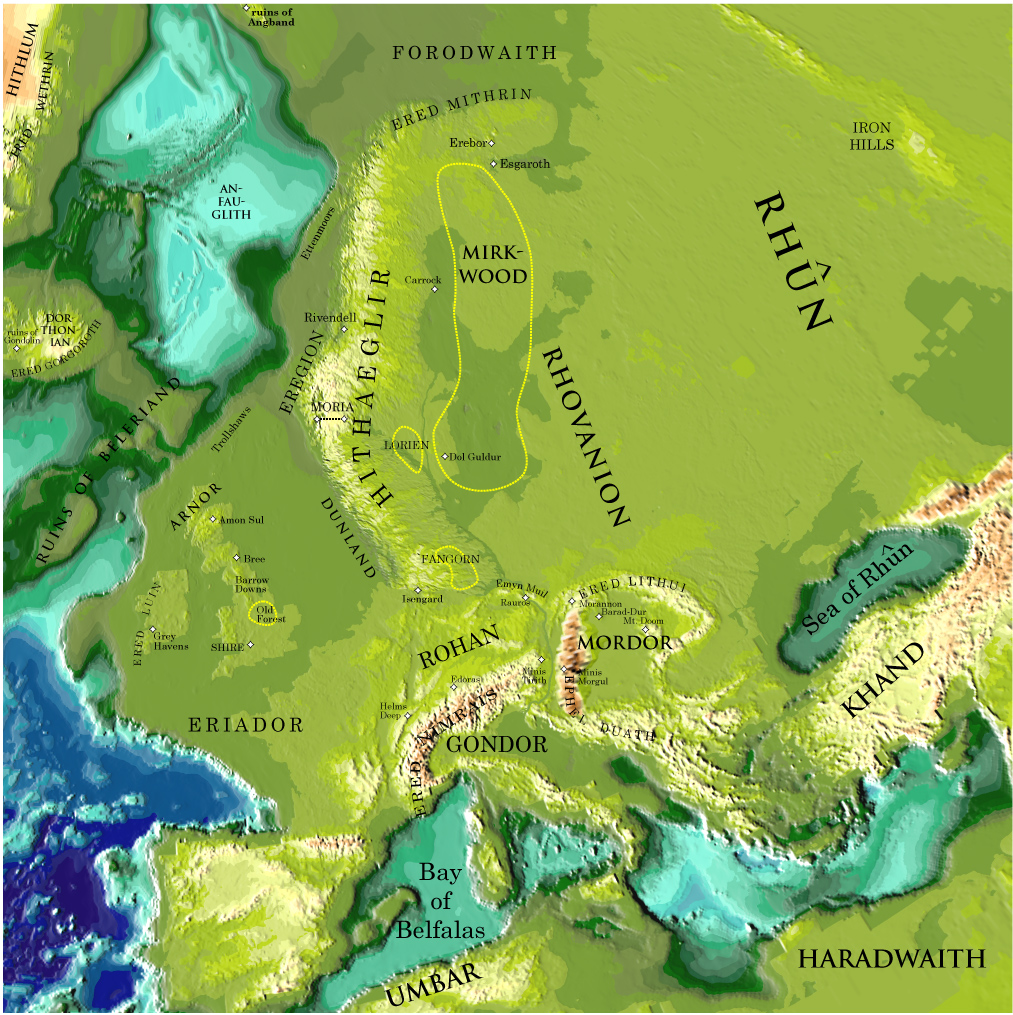
Another fortuitous discovery was this wonderful map of the northern European area, with vastly reduced sea levels, as it might map onto Tolkien's Middle Earth. I didn't realise that Tolkien explicitly said that ME was based on the real world, but this is so. Peter Bird has pulled and squeezed the ME map to fit it onto Europe, placing Tolkien's Shire roughly where the writer did - the English midlands.

(EDIT: I meant to say... Although if the sea levels are so low because of an ice age, where is all the ice?)

It's sobering to think that we modern humans have been roaming the world, much as we are today, for at least three or four times as long as the span of even the most distantly-recorded history. We know of things some 8,000-10,000 years ago; we know little of life in Ur or Sumer but there are tiny records. We know their names. But twenty thousand years ago or thirty thousand, in the same places, there were people living.

If they raised cities or farmed, they've left no trace, so it seems unlikely that they were other than wandering hunter-gatherers. They probably had no great warring empires or anything. But there was plenty of time. We trace our roots back towards the Romans, but really, our civilisation grew out of the ruins of theirs, a millennium later. The Arabs discovered science and technology before we Westerners, and the Chinese before them. A lot's happened in the last 3000 years or so.

But ten times that long ago, there were people much like us living where we do today. We know next to nothing about them. We don't know what languages they spoke, what religions they believed, what names they had.

Four times that far back - never mind forty millennia, think more like a hundred and sixty millennia - there were humans, people. The Neanderthals, with bigger brains than us, with a technology - fire and stone and wood, leather and bone, but still - and language. Names, places, stories, legends.

You can take almost any fictional account of fantastical histories - all the sword and sorcery epics you care to name - and plonk them down in that vast expanse of lost history. There's time enough for most of them to happen consecutively. That's a big thought, I feel. Takes some time to chew and digest. Nearly two hundred thousand years. Six or seven thousand successive generations of humans. Even just for modern man, sixteen hundred generations. Five times as long as the period back to our earliest records or archaeological digs of cities. Entire cultures being born, sequences of them prospering perhaps for longer than from Sumer to now, but lost two or three times as far back as from us to Sumer.
lproven: (Default)
I don't mean my life. I mean life on Earth.

I was reading today about efforts to create artificial life. This led me to read up on Mycoplasma genitalium, the simplest known free-living organism in the world. It's a parasitic bacterium that lives up people's willies.

But it's not the simplest bacterium. Oh no, that is currently Candidatus Carsonella ruddii. This is on its way to becoming an organelle, like a chloroplast or mitochondrion.

(These were once, a billion years ago or so, free-living bacterium-like organisms, but they got symbiotically involved with bigger cells and now play the role of functional parts of a bigger machine. They still have their own genome, though - their own DNA, quite separate from the main cells. Every cell in your body, every one of the billions of them, contains within it swarms of tiny little cells doing their own independent thing that are not actually related to you - they're an entirely different kind of life form to you, more distantly related to we mammals than, say, a mushroom. Bizarre, huh?)

C. ruddii has lost quite a lot of its genome. It can't survive alone any more, but it's got more of its own machinery left than chloroplasts or mitochondria do. It lives inside a special organ inside certain sap-sucking insects, something called a bacteriome. It's an organ which exists to provide a nice cosy place to live for symbiotic bacteria which live on the same plant sap as the insects. The thing is, plant sap is just sugary water. It's not very nutrious. We multicellular animals, we mammals and insects, need stuff like vitamins and so on to live and we can't make all of them ourselves. But bacteria, living alone as single cells, are made of sterner stuff. They have to be more self-sufficient. So, the sapsuckers keep an internal colony of bacteria going, and the bacteria turn sugar water into the vitamins and so forth that the sap-sucker needs to live on.

So far, so strange. This is a more intimate relationship than that that other multicellular organisms - like termites and cows - which eat things they can't live on have with their intestinal flora. Those lightweights just let the bugs break down stuff the hosts can't digest on their own.

Leafcutter ants, by contrast, invented agriculture millions of years before our first upright and less-hairy ancestors evolved, and farm fungi in their nests, which do the digestion for them.

But the sap-suckers do something cleverer. They use their internal symbionts not to break down but to synthesize new nutrients from simple sugars.

But wait. There's more.

There's a family of sap-sucking insects whose bacteriomes, an organ inside their own body, does not actually share their genetic makeup. An organ inside these things' bodies is actually a sort of relative, an internal non-identical twin which functions as an organ.

This is enough to make a biologist's head spin, but it gets weirder still. This organ has a bizarre genetic makeup all its own, unique in nature, because it's made up of polar bodies.

What's a polar body, you may well ask.

Well, when multicellular organisms have sex, both parents contribute half a set of chromosomes. The two halves make a whole. This means that mum & dad both have to make special sex cells with only half a set of chromosomes each. This happens through a special kind of cell division, called meiosis. The ordinary kind, when a cell just copies itself, is called mitosis.

To make an egg cell, a pre-egg-cell divides in half in a special way to make unequal halves. One part is really big, gets most of the parent and all the machinery, and the other is tiny and contains the leftover 2nd-half-a-set of chromosomes. This is the polar body. Normally, they're destroyed.

But in certain scale insects, the polar bodies combine with some other cells to make a special new kind of cell with, rather than one or two sets of chromosomes, five sets. Five!

And this bizarre thing is what grows into a bacteriome inside a scale insect.

JBS Haldane had it right: "the universe is not only queerer than we suppose, but queerer than we can suppose."
lproven: (Default)
A news story from the last couple of days which has rather piqued my interest.

NASA is showing some interest in some proposed "hyperdrives" based on the work of the obscure German theoretical physicist Burckhard Heim.

The Register: Scientists moot gravity-busting hyperdrive

The American Institute of Aeronautics and Astronautics voted the original paper best of the year. This is also being covered in the current New Scientist:

Take a leap into hyperspace

It's based on the work of Burkhard Heim, a deaf/blind and handless scientist who as a result eschewed the conventional scientific world:

Wikipedia on Heim

As a consequence, his work, a theory unifying General Relativity with quantum theory, is largely unknown, but is finally receiving some serious scholarly attention now, 4y after his death at 76yo.

Wikipedia: Heim theory

I find it fascinating but know next to nothing about theoretical physics so am utterly unequipped to judge whether it's the next scientific revolution or a load of tosh.

In other news: Yule was quite pleasant. Drove the length and longth of the Isle of Man; mother's reported opinion on my driving, "you're quite good. I'm impressed. I was told to forget it, you'd never do it, you didn't have the coordination."

Coming soon: snowboarding! Yay!

Profile

lproven: (Default)
Liam Proven

September 2025

S M T W T F S
 123456
78910111213
14151617181920
21222324252627
282930    

Syndicate

RSS Atom

Most Popular Tags

Style Credit

Expand Cut Tags

No cut tags
Page generated Jan. 25th, 2026 09:02 am
Powered by Dreamwidth Studios