Reading matter, pt 1 - SF
Oct. 31st, 2007 01:49 am![[personal profile]](https://www.dreamwidth.org/img/silk/identity/user.png) lproven
lprovenBeen reading up on lakes, seas and endorheic basins and the like as background for a barking idea I have concerning control of climate-change-induced sealevel rises. I ♥ Wikipedia.
Led me to a very interesting little novella concerning life in an alternate modern world where the Mediterranean Salinity Crisis never ended, 5.9MYa. I.e., when the barrier at Gibraltar never failed and so the Med never re-flooded. It's by noted alt-history author Harry Turtledove. One of the interesting spins he lends it is that - perhaps coincidentally - the Neanderthals never go extinct and coexist with we Cro-Magnon types.
Down in the Bottomlands. Recommended.
(Am also very vaguely looking at the possibility of going to Gibraltar for a while. It would be an interesting place to live, I think, and much of southern Spain and Portugal on one's doorstep.)
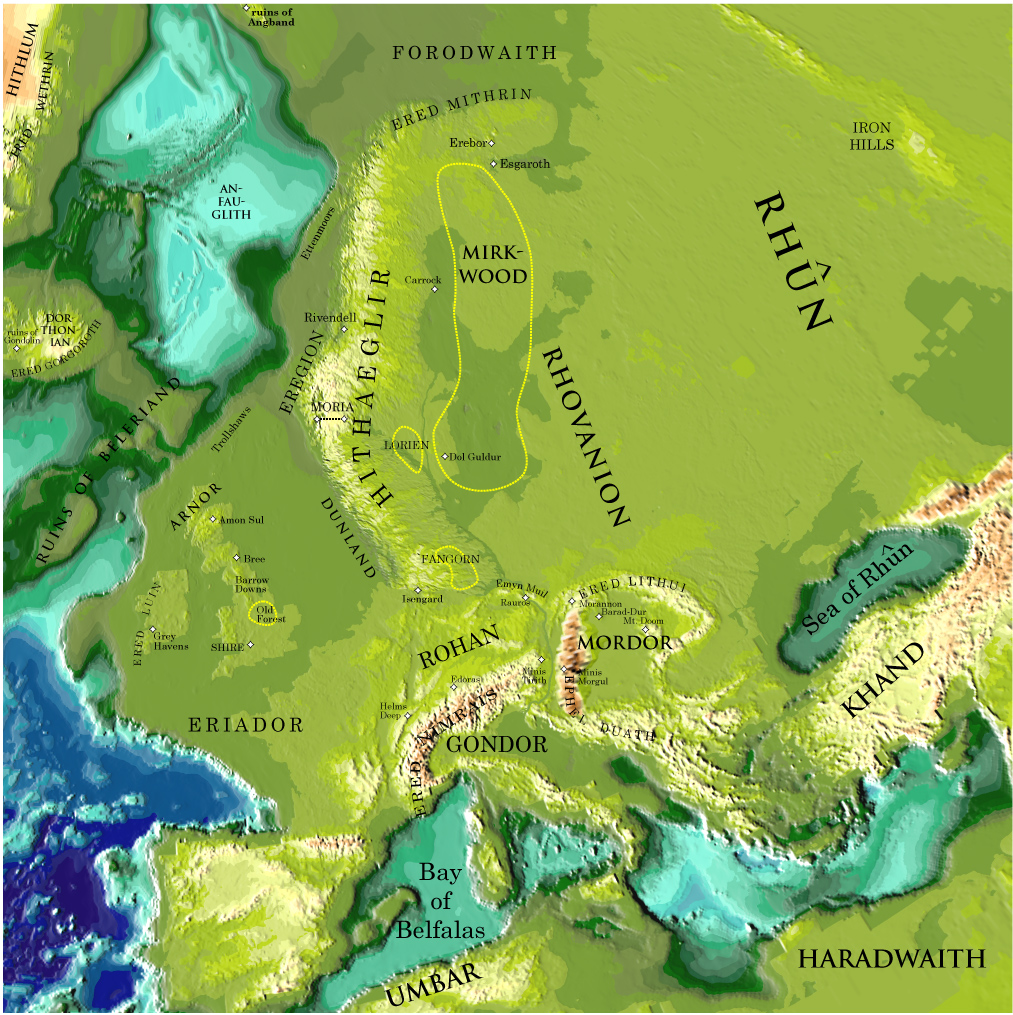
Another fortuitous discovery was this wonderful map of the northern European area, with vastly reduced sea levels, as it might map onto Tolkien's Middle Earth. I didn't realise that Tolkien explicitly said that ME was based on the real world, but this is so. Peter Bird has pulled and squeezed the ME map to fit it onto Europe, placing Tolkien's Shire roughly where the writer did - the English midlands.
(EDIT: I meant to say... Although if the sea levels are so low because of an ice age, where is all the ice?)
It's sobering to think that we modern humans have been roaming the world, much as we are today, for at least three or four times as long as the span of even the most distantly-recorded history. We know of things some 8,000-10,000 years ago; we know little of life in Ur or Sumer but there are tiny records. We know their names. But twenty thousand years ago or thirty thousand, in the same places, there were people living.
If they raised cities or farmed, they've left no trace, so it seems unlikely that they were other than wandering hunter-gatherers. They probably had no great warring empires or anything. But there was plenty of time. We trace our roots back towards the Romans, but really, our civilisation grew out of the ruins of theirs, a millennium later. The Arabs discovered science and technology before we Westerners, and the Chinese before them. A lot's happened in the last 3000 years or so.
But ten times that long ago, there were people much like us living where we do today. We know next to nothing about them. We don't know what languages they spoke, what religions they believed, what names they had.
Four times that far back - never mind forty millennia, think more like a hundred and sixty millennia - there were humans, people. The Neanderthals, with bigger brains than us, with a technology - fire and stone and wood, leather and bone, but still - and language. Names, places, stories, legends.
You can take almost any fictional account of fantastical histories - all the sword and sorcery epics you care to name - and plonk them down in that vast expanse of lost history. There's time enough for most of them to happen consecutively. That's a big thought, I feel. Takes some time to chew and digest. Nearly two hundred thousand years. Six or seven thousand successive generations of humans. Even just for modern man, sixteen hundred generations. Five times as long as the period back to our earliest records or archaeological digs of cities. Entire cultures being born, sequences of them prospering perhaps for longer than from Sumer to now, but lost two or three times as far back as from us to Sumer.
Led me to a very interesting little novella concerning life in an alternate modern world where the Mediterranean Salinity Crisis never ended, 5.9MYa. I.e., when the barrier at Gibraltar never failed and so the Med never re-flooded. It's by noted alt-history author Harry Turtledove. One of the interesting spins he lends it is that - perhaps coincidentally - the Neanderthals never go extinct and coexist with we Cro-Magnon types.
Down in the Bottomlands. Recommended.
(Am also very vaguely looking at the possibility of going to Gibraltar for a while. It would be an interesting place to live, I think, and much of southern Spain and Portugal on one's doorstep.)
Another fortuitous discovery was this wonderful map of the northern European area, with vastly reduced sea levels, as it might map onto Tolkien's Middle Earth. I didn't realise that Tolkien explicitly said that ME was based on the real world, but this is so. Peter Bird has pulled and squeezed the ME map to fit it onto Europe, placing Tolkien's Shire roughly where the writer did - the English midlands.
(EDIT: I meant to say... Although if the sea levels are so low because of an ice age, where is all the ice?)
It's sobering to think that we modern humans have been roaming the world, much as we are today, for at least three or four times as long as the span of even the most distantly-recorded history. We know of things some 8,000-10,000 years ago; we know little of life in Ur or Sumer but there are tiny records. We know their names. But twenty thousand years ago or thirty thousand, in the same places, there were people living.
If they raised cities or farmed, they've left no trace, so it seems unlikely that they were other than wandering hunter-gatherers. They probably had no great warring empires or anything. But there was plenty of time. We trace our roots back towards the Romans, but really, our civilisation grew out of the ruins of theirs, a millennium later. The Arabs discovered science and technology before we Westerners, and the Chinese before them. A lot's happened in the last 3000 years or so.
But ten times that long ago, there were people much like us living where we do today. We know next to nothing about them. We don't know what languages they spoke, what religions they believed, what names they had.
Four times that far back - never mind forty millennia, think more like a hundred and sixty millennia - there were humans, people. The Neanderthals, with bigger brains than us, with a technology - fire and stone and wood, leather and bone, but still - and language. Names, places, stories, legends.
You can take almost any fictional account of fantastical histories - all the sword and sorcery epics you care to name - and plonk them down in that vast expanse of lost history. There's time enough for most of them to happen consecutively. That's a big thought, I feel. Takes some time to chew and digest. Nearly two hundred thousand years. Six or seven thousand successive generations of humans. Even just for modern man, sixteen hundred generations. Five times as long as the period back to our earliest records or archaeological digs of cities. Entire cultures being born, sequences of them prospering perhaps for longer than from Sumer to now, but lost two or three times as far back as from us to Sumer.